Saints
“Golden-Mouth”
Archbishop of Constantinople · Golden-Mouth
The greatest preacher of the Church, who spoke without notes for hours and whom the people called Chrysostom, 'Golden-Mouth', for the sweetness and force of his words.
His life
Born in Antioch around 349 to a noble family, John was reared by his widowed mother Anthusa, who refused remarriage in order to give her son a Christian upbringing. He studied rhetoric under the famous pagan teacher Libanius, who is said to have wished John would succeed him 'if the Christians had not stolen him.'
After his mother's repose he withdrew to the mountains outside Antioch to practice asceticism, spending two of those years in a cave learning the Scriptures by heart. The harshness of the regime broke his health, and he returned to the city, was ordained deacon, then presbyter, and for twelve years preached the homilies that fill fifteen volumes of his collected works.
It was at Antioch, in the Lent of 387, that he became the voice of a terrified city. When the people, crushed by a new tax, had thrown down and broken the statues of the emperor Theodosius and dreaded his vengeance, John preached the twenty-one Homilies on the Statues, holding the city together with the fear of God and the hope of mercy until imperial pardon came. The people never forgot it, and it was there that the name Golden-Mouth fastened to him.
In 397 he was seized, almost kidnapped, and brought to Constantinople to be made archbishop of the capital. He gave away the silver of the patriarchate, fed the poor, and from the pulpit rebuked the luxury of the court. The empress Eudoxia, whose vanity he had publicly named, twice procured his exile.
The second exile killed him. Sent on foot through the Armenian highlands in the winter of 407, he died at Comana in Pontus on September 14, his last words: 'Glory to God for all things.'
Thirty-one years later, in 438, his relics were brought home to Constantinople in triumph, and the emperor Theodosius II laid his face upon the coffin to beg forgiveness for the wrong his parents had done the saint. The Church numbers him with St. Basil the Great and St. Gregory the Theologian as one of the Three Hierarchs, and keeps him as the author of the Divine Liturgy most often served in Orthodox churches to this day.
In his own words
Let no one fear death, for the death of the Savior has set us free.
For many of our conceptions about God, we are unable to express, as also many things we express, but have not strength to conceive of them. That God is everywhere, we know; but how, we no longer understand. Lo, we speak, and do not understand.
Nothing is more frigid than a Christian, who cares not for the salvation of others.
Nothing is so important as thy brother's salvation.
Nothing is worse than envy; to destroy another it destroys itself also.
He that loves never can hate.
Nothing is more blessed than that chain.
Almsgiving I mean, fits not only the rich, but also the needy.
God has bestowed a power on priests greater than that of our natural parents.
For neither of these did the Law avail, but grace was sufficient for both.
Glory to God for all things.
Writings
Late 4th c.
Read in every Orthodox church on Pascha night
The brief sermon, read every Pascha, that calls all to the table of the Resurrection regardless of the hour they came to labor.
Open work →
c. 386
The six books, complete
The weight of the priesthood, the manner of those who would bear it, and why the young Chrysostom fled ordination.
Open work →
c. 390
The complete ninety homilies
The earliest complete commentary on Matthew to survive: Chrysostom's homilies through the whole First Gospel, on the Sermon on the Mount, the parables, and the discipleship of the Kingdom.
Open work →
c. 391
The complete eighty-eight homilies
Chrysostom's verse-by-verse preaching through the whole Fourth Gospel, all eighty-eight homilies, the longest patristic treatment of any New Testament book.
Open work →
c. 391
The complete thirty-two homilies
Chrysostom's verse-by-verse exposition of St. Paul's greatest epistle, on grace, faith, the law, and life in the Spirit, across all sixteen chapters.
Open work →
c. 403
The complete thirty-four homilies
Delivered near the end of his life and published from a hearer's notes, Chrysostom's reading of Hebrews on Christ the High Priest and the better covenant.
Open work →
c. 392
The complete forty-four homilies
Chrysostom's pastoral reading of a divided church, on unity, the gifts, the Eucharist, the resurrection of the body, and the hymn to love in chapter thirteen.
Open work →
c. 392
The complete thirty homilies
The most personal of Paul's letters expounded: affliction and comfort, the ministry of reconciliation, godly sorrow, and strength made perfect in weakness.
Open work →
c. 392
The complete twenty-four homilies
On the mystery of the Church as the body of Christ, grace through faith, the unity of the Spirit, and the whole armour of God.
Open work →
c. 400
The complete fifteen homilies
Joy from a prison cell: the self-emptying of Christ, pressing toward the prize, and learning in whatsoever state to be content.
Open work →
c. 399
The complete twelve homilies
Christ the image of the invisible God and the fullness of the Godhead, against every philosophy that would dim His supremacy.
Open work →
c. 400
The complete eleven homilies
Encouragement to a young church on holiness, brotherly love, work, and the coming of the Lord and the resurrection of those who sleep.
Open work →
c. 400
The complete five homilies
On patience under persecution, the man of sin and the restrainer, and the duty to stand fast and to labour quietly for one's bread.
Open work →
c. 397
The complete eighteen homilies
A handbook for the shepherd: sound doctrine, prayer, the qualifications of bishops and deacons, the care of widows, and contentment with godliness.
Open work →
c. 397
The complete ten homilies
Paul's last letter: fan into flame the gift of God, endure hardship as a good soldier, and the charge to preach the word in season and out.
Open work →
c. 397
The complete six homilies
On ordering the churches of Crete, the character of elders, sound teaching, and the grace of God that trains us to live soberly and godly.
Open work →
c. 397
The complete three homilies
On the runaway slave Onesimus returned as a brother: a short letter Chrysostom reads as a lesson in mercy, restitution, and the dignity of every soul.
Open work →
c. 400
The complete fifty-five homilies
The only complete patristic commentary on Acts to survive: the descent of the Spirit, the life of the first community, and the apostolic preaching from Jerusalem to Rome.
Open work →
c. 395
The complete commentary, all six chapters
Chrysostom's continuous commentary on Paul's defense of the Gospel of grace: justified by faith and not by the law, and called to the freedom of the children of God.
Open work →
Licensed Works
These works are licensed and copyrighted by their publishers and cannot be hosted on Purify. As an Amazon Associate, Purify earns from qualifying purchases.
Events during this saint's life
Explore the interactive timeline →Holy St. John Chrysostom, pray to God for us.
St. Vladimir's Seminary Press · 1986
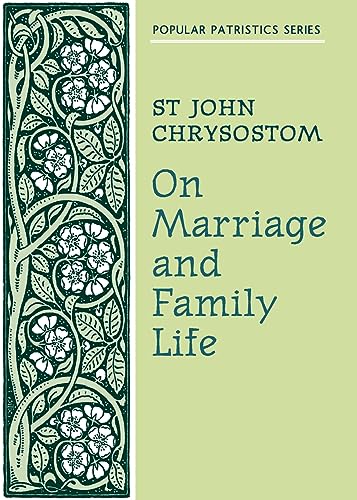
A practical patristic vision for husbands, wives, and children, the household as the little Church. Drawn from the homilies on Ephesians and Colossians.