The Mother of God

“Ever-Virgin Mary”
The Most Holy Theotokos
Mother of God · Panagia
The Mother of God, more honorable than the Cherubim and beyond compare more glorious than the Seraphim: the Virgin who bore the uncontainable Word, and who stands first among all the saints.
43 readers asking
- Born
- Tradition: Jerusalem, to Ss. Joachim and Anna
- Reposed
- The Dormition, c. 41 (Jerusalem)
- See
- Jerusalem
- Feast
- August 15 · September 8 · November 21 · March 25 · October 1 · December 26
Her titles
- Theotokos (the God-bearer)
- Ever-Virgin
- Mother of God
- Panagia (the All-Holy)
- More Honorable than the Cherubim
- Queen of Heaven
- The New Eve
- Joy of All Who Sorrow
Her life
The Most Holy Theotokos stands at the heart of the Church's love and wonder: a daughter of the fallen race of Adam who became the Mother of its Maker. The Orthodox Church does not worship her, for worship belongs to God alone; but it honors her above every other creature, as the one who gave her own flesh to the eternal Son and so opened the way of our salvation.
The Church holds that she was born to the aged and childless Joachim and Anna, who had prayed long for a child and vowed to dedicate her to God. Her birth is kept as the first of the year's great feasts, on the eighth of September. While still a small child she was brought to the Temple in Jerusalem and, the tradition relates, received to be raised within its precincts, a feast the Church keeps on the twenty-first of November as the Entrance of the Theotokos.
Betrothed in her youth to the righteous Joseph, a guardian of her virginity, she was living quietly at Nazareth when the Archangel Gabriel was sent to her. He greeted her as 'full of grace' and told her she would bear the Son of the Most High. To the angel's word she gave the answer on which, the Fathers say, the whole world waited: 'Behold the handmaid of the Lord; be it unto me according to thy word.' In that free consent the Word was made flesh.
Carrying the Lord within her, she went into the hill country to her kinswoman Elizabeth, and there poured out the song the Church has never ceased to sing, the Magnificat: 'My soul doth magnify the Lord.' In Bethlehem she brought forth her firstborn and laid him in a manger; she kept the words of the shepherds and the magi and pondered them in her heart; and she fled with the child into Egypt from the sword of Herod.
She appears again at the beginning of his ministry, at the wedding in Cana of Galilee, where her quiet command to the servants remains her counsel to every Christian: 'Whatsoever he saith unto you, do it.' Through the years of his preaching she followed at a distance, a sword piercing her own soul, as the elder Symeon had foretold over the infant in the Temple.
She did not turn away at the end. While the disciples fled, she stood at the foot of the Cross; and from there her dying Son gave her to the beloved disciple, and the disciple to her: 'Behold thy mother.' In her the Church sees the mother of all who are born anew in Christ.
After the Resurrection and the Ascension she remained with the apostles, and was among them in the upper room when the Holy Spirit descended at Pentecost. She lived out her remaining years under the care of the Apostle John, honored by the young Church as its mother.
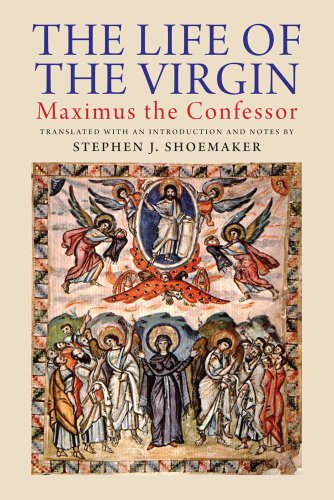
The Church holds that when she fell asleep, the apostles were gathered miraculously to her side; that her Son received her soul; and that on the third day he raised her body and took her to himself, the first to share fully in the resurrection he had won. This is the Dormition, kept on the fifteenth of August after a fast, the last of the year's great feasts and the seal of her life. The Church sings of her as 'more honorable than the Cherubim and beyond compare more glorious than the Seraphim,' and runs to her protection in every need.
Most Holy Theotokos, save us.