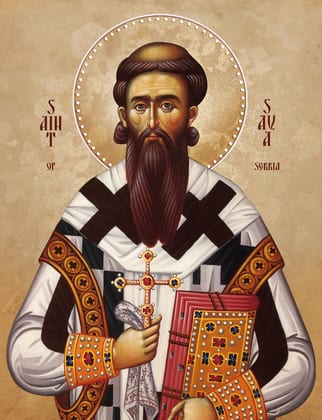
St. Sava of Serbia
First Archbishop of SerbiaFeast January 14
Be the first to ask
The youngest son of the Grand Prince Stefan Nemanja, who forsook a royal future for the monastic life on Mount Athos and became the first Archbishop of an autocephalous Serbian Church — the father of Serbian letters, law, and Christian nationhood.
- Born
- c. 1174 (Rastko Nemanjić)
- Reposed
- January 14, 1236 (Tarnovo, Bulgaria)
- See
- Serbia (Žiča)
- Feast
- January 14
He was born around 1174 as Rastko, the youngest son of the Grand Prince Stefan Nemanja. Given a province to govern while still a youth, he longed instead for God; and at about the age of seventeen he fled in secret to Mount Athos, where he was tonsured a monk with the name Sava and gave himself wholly to prayer and obedience.
His father followed him to the Holy Mountain, becoming the monk Simeon, and together they restored the abandoned monastery of Hilandar as a spiritual home for the Serbian people. There Sava composed its rule and grew into a teacher of monks, until the affairs of his homeland drew him back. He brought the relics of his father Simeon to Serbia to reconcile his quarreling brothers, and the wonders that attended them quieted the strife.
Seeing that his people needed a Church of their own, Sava traveled in 1219 to Nicaea, where the Emperor and the Ecumenical Patriarch Manuel I then resided in exile. From them he obtained the autocephaly — the self-governing freedom — of the Serbian Church, and was himself consecrated its first Archbishop. Returning home, he organized bishoprics across the land, ordained clergy, founded schools, and translated the books of the Church into the language of his people.
He gave the Serbs not only a hierarchy but a Christian civilization: he compiled the Nomocanon, the first body of Serbian law uniting the canons of the Church with the statutes of the state; he wrote the Life of his father St. Simeon and the typika for Hilandar and his hermitage at Karyes; and he is honored as the founder of Serbian literature, medicine, and education. Twice he made the long pilgrimage to the holy places of the East.
Returning from his second pilgrimage to the Holy Land, he fell ill at Tarnovo in Bulgaria and reposed there on the fourteenth of January, 1236. His relics were carried home to the monastery of Mileševa, where they became a fountain of healing and a sign of Serbian identity, until in 1594 the Ottoman Sinan Pasha, to break the people's spirit, burned them upon the hill of Vračar in Belgrade — where the great church dedicated to St. Sava now stands. He is loved by the Serbs above all their saints, as the enlightener and father of their nation.
Holy St. Sava of Serbia, pray to God for us.