Saints

“The Great”
St. Photius the Great
Patriarch of Constantinople · Pillar of Orthodoxy · Defender of the Procession of the Spirit
The most learned man of his age and twice Patriarch of Constantinople, who answered the Frankish addition of the Filioque to the Creed with the first full Eastern treatise on the procession of the Holy Spirit, presided over the great reconciling council of 879-880, and sent the mission of Cyril and Methodius to the Slavs. The Church honours him as one of the three Pillars of Orthodoxy, with St. Gregory Palamas and St. Mark of Ephesus.
1 reader asking
- Born
- c. 810 (Constantinople)
- Reposed
- February 6, 893 (Armenia)
- See
- Constantinople
- Feast
- February 6
His life
Photius was born in Constantinople around the year 810, into a noble and devout family that suffered for the holy icons during the second iconoclast persecution; his great-uncle was St. Tarasius, the Patriarch who had presided over the Seventh Ecumenical Council. He received and then surpassed the finest education the empire could give, mastering grammar, rhetoric, philosophy, theology, medicine, and the natural sciences, and was reckoned by his own and later ages the most learned man of the Byzantine world. He taught publicly in Constantinople, numbering among his hearers Constantine, the future St. Cyril, apostle of the Slavs, and rose to be chief secretary of state and a senator.
In 858 the Emperor's government deposed the Patriarch Ignatius, and Photius, still a layman, was raised through the clerical orders in a few days and enthroned as Patriarch of Constantinople. The disputed manner of his elevation, and the rival claims of the partisans of Ignatius, set off a long contest with Rome. Pope Nicholas I, intervening in the affair and pressing the claims of the Roman see over the East, declared against Photius; Photius in turn, in 867, denounced as an innovation the Frankish insertion of the Filioque, the clause that the Holy Spirit proceeds from the Father and the Son, which the missionaries in Bulgaria had begun to teach.
Set aside for a time when Ignatius was restored, and reconciled with him before Ignatius's death, Photius was recognised again as Patriarch, and in 879-880 a great council of some three hundred and eighty bishops met in Constantinople, with the legates of Pope John VIII consenting, and restored full communion between the Churches, condemned any addition to the Creed, and vindicated Photius. Many in the Orthodox East have counted this as the Eighth Ecumenical Council, the last at which East and West confessed the Creed together without the Frankish addition.
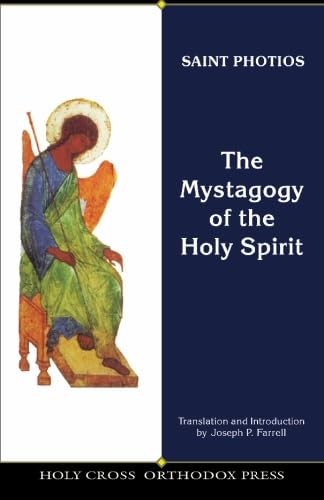
Against that addition Photius wrote the Mystagogy of the Holy Spirit, the first systematic Eastern answer to the Filioque, arguing from Scripture and the Fathers that the Spirit proceeds from the Father alone, as the Lord Himself had taught. His vast learning he set down in the Bibliotheca, or Myriobiblon, a review of some two hundred and eighty volumes of ancient pagan and Christian literature he and his circle had read, which preserves for us the substance of many works since lost. He gathered his replies on Scripture and doctrine in the Amphilochia, a long series of questions answered for his friend Amphilochius of Cyzicus; he compiled a Lexicon of difficult words for students of the older Greek; and he left a great body of Homilies, among them the two famous sermons preached when the fleet of the Rus' first threatened the City in 860, and many Letters of pastoral and theological weight.
He was a missionary patriarch. Under him the Bulgarians were brought into the Church, and he sent the brothers Constantine, his own pupil, and Methodius to evangelise the Slavs of Moravia in their own tongue, the beginning of the Christian enlightenment of the whole Slavic world. He reposed in exile at a monastery in Armenia on the sixth of February, 893, and was in time glorified by the Church. The Orthodox keep his memory on the sixth of February and honour him, with Gregory Palamas and Mark of Ephesus, as one of the three great Pillars of Orthodoxy who in three different ages defended the faith against the innovations of the West.
Holy St. Photius the Great, pray to God for us.