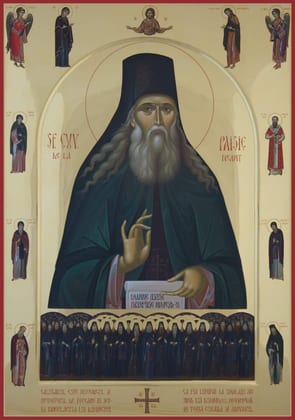
The Ukrainian-born elder who, from the monasteries of Moldavia, revived the inward prayer of the heart and rendered the Philokalia into Slavonic, sending the hesychast tradition out across the whole Orthodox East.
- Born
- December 21, 1722 (Poltava)
- Reposed
- November 15, 1794 (Neamț Monastery)
- See
- Neamț Monastery
- Feast
- November 15
He was born in Poltava in 1722 and named Peter at baptism. After early studies at the Kyiv academy, which he found barren of living prayer, he left to seek out the monks of the forests and the Carpathians, taking the name Plato when he was tonsured.
His search for living elders carried him at last to Mount Athos, where he settled as a hermit and gathered around himself a brotherhood drawn by his teaching on the Jesus Prayer. Ordained and given the name Paisius, he led his community first on the Holy Mountain and then, when their numbers outgrew it, to the principalities of Moldavia and Wallachia.
As abbot of the great monastery of Neamț he formed a community of hundreds of monks of many tongues, ordering its life around obedience, the reading of the Fathers, and the unceasing prayer of the heart. He set his most learned monks to the labor of collating Greek manuscripts and correcting the Slavonic texts of the ascetic Fathers.
From that labor came his Slavonic Philokalia (Dobrotolubiye), printed in 1793, which carried the hesychast teaching into Russia and the Slavic lands, where it shaped the elders of Optina and the spiritual revival of the nineteenth century. He reposed at Neamț on November 15, 1794.
Events during this saint's life
Explore the interactive timelineBooks in print
These works are licensed and copyrighted by their publishers and cannot be hosted on Purify. As an Amazon Associate, Purify earns from qualifying purchases.
- Little Russian Philokalia, Vol. IV: St. Paisius VelichkovskyBy St. Paisius Velichkovsky · St. Herman of Alaska Brotherhood, 1994A collection of the writings and counsels of St. Paisius, the renewer of Hesychasm and the Jesus Prayer in the Slavic lands, gathered in the Brotherhood's Little Russian Philokalia series.Buy on Amazon
- Blessed Paisius VelichkovskyAbout Schemamonk Metrophanes · St. Herman of Alaska Brotherhood, 1994The classic life of St. Paisius, tracing his journey from Ukraine to Mount Athos and Moldavia, and his labors translating the Philokalia that rekindled the prayer of the heart across Orthodoxy.Buy on Amazon
Holy St. Paisius Velichkovsky, pray to God for us.