Purify
TodayBiblePrayersSaints
Discover
CalendarCommunityShop
SupportAccount

The Bible

  • Old Testament
  • New Testament
  • Search

The Saints

  • The Saints
  • The Fathers
  • Writings

The Library

  • Reading
  • Discover
  • Councils
  • Topics
  • Heresies
  • Shop

The Calendar

  • Today
  • This month
  • Pascha
  • The fasts

The Prayer

  • Open today's prayer
  • Morning Rule
  • Evening Rule
  • The Jesus Prayer
  • Learn to Pray

About this work

  • About
  • Purify Plus
  • Privacy
  • Terms
  • FAQ
  • Support the work
  • What's new
  • Account

Find us

Discord@purifymylife@purify.app@purifymylife
Language
Purify

Glory to God for all things.

© 2026 · 1.3 · Public-domain texts unless otherwise noted.

Saints

Mt
Icon of St. Maximus the Confessor

“The Confessor”

St. Maximus the Confessor

Monk · Theologian of the Two Wills of Christ

The monk who almost alone defended the Orthodox confession that Christ has two natural wills, divine and human, against the imperial monothelite party, and was tortured and exiled for it; called 'the Confessor' for the witness of his maimed body.

8 readers askingSign in to request
Born
c. 580 (Constantinople)
Reposed
August 13, 662
See
Constantinople (lay)
Feast
January 21 · August 13

His life

Born in Constantinople of a noble family, Maximus rose to become first secretary to the emperor Heraclius. In his early thirties he resigned all worldly office and entered the monastery of Chrysopolis across the Bosphorus, where he was tonsured and took up the strict ascetic life.

When the empire and patriarchate adopted monothelitism, the doctrine that Christ had only one will, Maximus left the East and travelled to North Africa and Rome, persuading bishops and councils that the doctrine was a betrayal of Chalcedon. At the Lateran Council of 649, called at his urging, monothelitism was condemned.

For this he was arrested and brought back to Constantinople. He was tried, exiled, brought back, tried again, and finally, when he refused to recant, his tongue was cut out and his right hand cut off, that he might neither speak nor write the truth he confessed.

He was exiled to the Caucasus, where he died on August 13, 662. Twenty years later the Sixth Ecumenical Council of 681 affirmed everything he had taught and condemned everything he had opposed. The Church gave him the name 'Confessor' for the witness of his maimed body and silent tongue.

In his own words

“Perhaps the holy Paul said he knew the knowledge of the Word of God in part, for He is only known to a limited degree on the basis of His activities. For knowledge concerning His substance and person in Himself is to everyone alike, both to angels and humans.
200 Chapters on Theology 2.76, on partial knowledge of God

Writings

Read his works

1 of 1 work
  • c. 626

    Four Hundred Chapters on Love

    First Century

    Maximus's most-read work: a ladder of short maxims on the ascetic life, organized in four centuries of one hundred chapters each.

    • Love
    • Asceticism
    • Theology
    • Will

    Open work →

Licensed Works

Books in print

These works are licensed and copyrighted by their publishers and cannot be hosted on Purify. As an Amazon Associate, Purify earns from qualifying purchases.

Holy St. Maximus the Confessor, pray to God for us.

Cover of Maximus the Confessor

Maximus the Confessor

The Early Church Fathers

About Andrew Louth

Routledge · 1996

Louth's introduction with fresh translations of key short works. The standard entry point into Maximus's cosmic Christology.

Buy on Amazon →
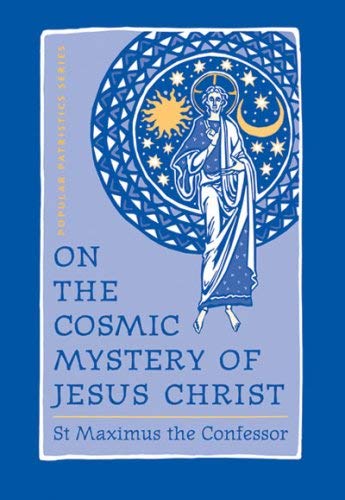
  • Cover of On the Cosmic Mystery of Jesus Christ

    On the Cosmic Mystery of Jesus Christ

    Popular Patristics Series

    By Maximus the Confessor

    St. Vladimir's Seminary Press · 2003

    Selected Ambigua and Questions to Thalassius translated by Paul Blowers and Robert Wilken, Maximus at his most luminous on the incarnation as the goal of creation.

    Buy on Amazon →
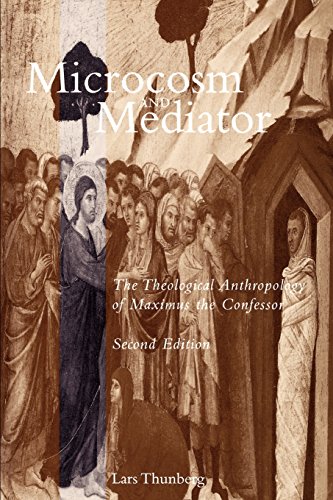
  • Cover of Microcosm and Mediator

    Microcosm and Mediator

    The Theological Anthropology of Maximus the Confessor

    About Lars Thunberg

    Open Court · 1995

    Thunberg's classic study of Maximian anthropology, the logoi, the union of natures, the deifying ascent through the modes of human existence. The patristic depth from which Palamas later drew the essence-energies vocabulary.

    Buy on Amazon →
  • Events during this saint's life

    • 680–681The Sixth Ecumenical Council at Constantinople→
    Explore the interactive timeline →

    At a glance

    Born
    c. 580 (Constantinople)
    Reposed
    August 13, 662
    See
    Constantinople (lay)
    Feast
    January 21 · August 13