Saints

“The Philosopher”
St. Justin Martyr
Philosopher and Martyr · Apologist of the Second Century
The first great Christian philosopher, a convert who kept the philosopher's cloak and gave his life at Rome, leaving the earliest full defense of the faith and the oldest description we possess of Baptism and the Eucharist.
3 readers asking
- Born
- c. 100 (Flavia Neapolis, Samaria)
- Reposed
- c. 165 (Rome)
- See
- Rome (martyred)
- Feast
- June 1
His life
Justin was born around the year 100 at Flavia Neapolis in Samaria, the ancient Shechem and the modern Nablus, to a pagan Greek family. From his youth he was seized by the longing to know God, and he passed in turn through the schools of the philosophers, the Stoics, the Peripatetics, the Pythagoreans, and at last the Platonists, hoping by reason to come to the vision of the divine.
His conversion he tells in his own words in the Dialogue with Trypho. Walking one day by the sea, he met an old man who questioned his confidence in the philosophers and pointed him beyond them to the Hebrew prophets, who had spoken by the Spirit of God and foretold Christ. The old man bade him pray that the gates of light be opened to him. Reading the Prophets, and seeing the steadfastness of the Christians under persecution, Justin found the philosophy he had long sought, and was baptized.
He did not lay aside the philosopher's cloak but wore it still as a Christian, holding that Christ is the Word, the Logos, in whom all reason shares, so that whatever truth the Greeks had spoken belonged already to Christ. He travelled and taught, and settled at last in Rome, where he opened a school and disputed publicly with pagans and heretics, among them Crescens the Cynic, whose enmity, the tradition says, brought about his death.
From Rome he addressed his two Apologies, the first to the emperor Antoninus Pius and the Roman Senate around the year 155, the second occasioned by the unjust execution of Christians under the prefect Urbicus. In them he asked only that Christians be judged by their deeds and not condemned for the name alone, and he set down for all time the shape of Christian worship and the meaning of the Mysteries (the sacraments).
Denounced as a Christian, Justin was brought with six companions before Rusticus, the prefect of Rome, around the year 165. He confessed Christ without wavering, refused to sacrifice to the gods, and was scourged and beheaded. The record of his trial, the Acts of Justin, survives from the hand of those who witnessed it. The Church honours him as Justin the Philosopher and Martyr, and keeps his memory on the first of June.
In his own words
But straightway a flame was kindled in my soul; and a love of the prophets, and of those men who are friends of Christ, possessed me; and whilst revolving his words in my mind, I found this philosophy alone to be safe and profitable.
Whatever things were rightly said among all men, are the property of us Christians.
Writings
Read his works
c. 155
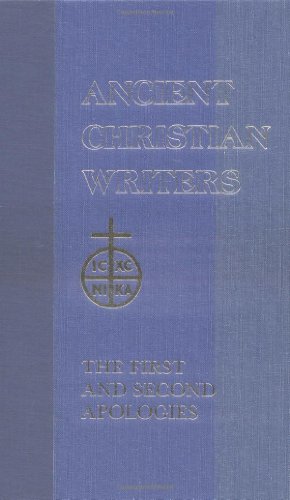
The First Apology
To the Emperor Antoninus Pius, in defense of the Christians
Justin's open letter to the emperor and the Roman Senate: a plea that Christians be tried for their deeds and not their name, an answer to the charges of atheism and immorality, and the earliest full account we possess of how Christians baptize and celebrate the Eucharist.
- Apologetics
- Eucharist
- Baptism
- Worship
Open work →
c. 155
The Second Apology
To the Roman Senate, on the punishment of Christians
A shorter appeal, written after three Christians were put to death at Rome, pressing the injustice of punishing the name alone and teaching that the seed of the Word is sown in all people, so that whatever was rightly said by anyone belongs to Christians.
- Apologetics
- Martyrdom
- Providence
- The Logos
Open work →
c. 160
Dialogue with Trypho the Jew
The longest surviving second-century dialogue between a Christian and a Jew
Justin's record of a two-day conversation at Ephesus with Trypho, a learned Jew: his own road through philosophy to Christ, and a long argument from the Hebrew Scriptures that Jesus is the promised Messiah, that a new covenant has been given, and that the Church is the true Israel.
- Scripture
- Prophecy
- Christ
- Covenant
Open work →
Holy St. Justin Martyr, pray to God for us.