Saints

“Defender of the Holy Icons”
St. John of Damascus
Hymnographer · Defender of the Holy Icons
The last great Father of the East, who under Muslim rule defended the veneration of holy icons against the iconoclast emperors and gave the Church its definitive systematic theology.
29 readers asking
- Born
- c. 675 (Damascus)
- Reposed
- December 4, 749
- See
- Lavra of St. Sabbas, Palestine
- Feast
- December 4
His life
John was born into the Mansur family, Christian Arabs who served as chief financial officers of the Umayyad Caliphate at Damascus. He inherited the post from his father and held it under the caliph Abd al-Malik before resigning all worldly office to enter the Lavra of St. Sabbas in the Judean desert.
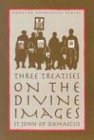
When the Byzantine emperor Leo III issued the edicts of iconoclasm in 726 and 730, John, safely beyond Leo's reach in the caliphate, wrote three Apologies in defense of the holy images. He argued that since the invisible God had become visible flesh in Christ, the matter of the image was now itself sanctified.
Tradition holds that the iconoclast emperor procured a forged letter in John's hand and sent it to the caliph, who ordered John's right hand cut off. John prayed before an icon of the Theotokos; in the morning the hand was restored. The Theotokos icon called 'Tricheirousa', 'of the Three Hands', still stands at Hilandar Monastery on Mount Athos in memory of the miracle.
He spent the rest of his life at St. Sabbas writing hymns, the Paschal Canon among them, and his Fountain of Knowledge, whose third part, the Exact Exposition of the Orthodox Faith, became the East's standard summa.
In his own words
Energy is the efficacious and substantial activity of nature: the capacity for energy is the nature from which proceeds energy: the product of energy is that which is effected by energy: and the agent of energy is the person or subsistence which uses the energy.
Writings
Read his works
Licensed Works
Books in print
These works are licensed and copyrighted by their publishers and cannot be hosted on Purify. As an Amazon Associate, Purify earns from qualifying purchases.
Holy St. John of Damascus, pray to God for us.