Saints

“Equals-to-the-Apostles”
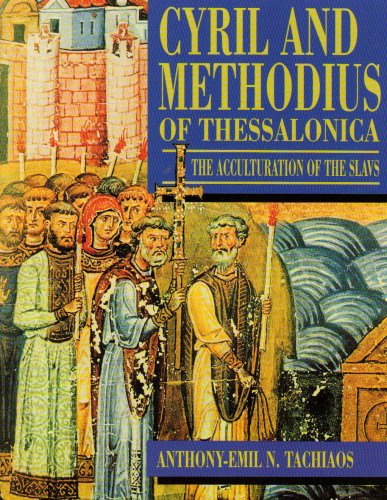
Saints Cyril and Methodius
Equals-to-the-Apostles · Enlighteners of the Slavs · Teachers of the Slavonic Letters
The two brothers from Thessaloniki who carried the Gospel to the Slavs in their own tongue. To do it they devised the first Slavic alphabet and rendered the Scriptures and the services of the Church into Slavonic, becoming the fathers of an entire Christian civilisation and the patrons of all the Slavic peoples.
3 readers asking
- Born
- c. 815 (Methodius) and c. 827 (Cyril), Thessaloniki
- Reposed
- February 14, 869 (Cyril, Rome) and April 6, 885 (Methodius, Moravia)
- See
- Moravia (mission); Methodius, Archbishop of Sirmium
- Feast
- May 11 · February 14 · April 6
His life
Constantine, who took the name Cyril at the end of his life, and his elder brother Methodius were born in Thessaloniki, the sons of a senior officer of the city, around the years 827 and 815. Thessaloniki was ringed by Slavic settlements, and the brothers grew up knowing the Slavic speech of the region as well as their native Greek. Methodius first followed his father into the imperial service and governed a Slavic province, then withdrew to the monastic life on Mount Olympus in Bithynia. Constantine, called 'the Philosopher' for his learning, studied at Constantinople under the future Patriarch Photius and others, was ordained, and taught philosophy in the capital; he was sent on imperial embassies to the Arabs and, with his brother, to the Khazars, disputing in defence of the Faith.
About the year 862 Prince Rastislav of Great Moravia asked the Emperor and the Patriarch Photius for teachers who could instruct his people in the Christian faith in their own language. The brothers were chosen. Before they set out, Constantine devised an alphabet fitted to the sounds of the Slavic tongue, the Glagolitic letters, and with it began to put the word of God into Slavonic. As a preface to the Gospel he composed the Proglas, a poem in Slavonic verse in praise of the letters and of the Scriptures in the people's own speech, the first original poem of Slavic literature.
In Moravia the brothers translated and taught. They rendered into Old Church Slavonic the Gospel and the New Testament, the Psalter, and the liturgical books needed for the services, so that the Slavs could hear the Liturgy and the Hours in a tongue they understood. With these they gave the young Church its law as well as its worship: the Zakon Sudnyj Ljudem, the Court Law for the People, the earliest Slavic legal code, and a Slavonic Nomocanon, the canons of the Church arranged for the governance of the new Christian nation. After Cyril's death Methodius carried on the labour, completing the translation of nearly the whole of the Old Testament.
Summoned to Rome to answer those who held that God might be worshipped only in Hebrew, Greek, and Latin, the brothers defended the right of every people to praise God in its own tongue, and Pope Adrian II blessed the Slavonic books. At Rome Constantine fell ill, took the monastic habit with the name Cyril, and reposed on the fourteenth of February, 869, charging Methodius to finish their work. Methodius was consecrated archbishop for the Slavs and laboured on amid bitter opposition from the Frankish clergy, who imprisoned him for a time; he reposed in Moravia on the sixth of April, 885. Their disciples, driven out after Methodius's death, carried the Slavonic letters south to Bulgaria and Ohrid, where the alphabet now called Cyrillic took its mature form and spread to the Serbs, the Bulgarians, and at last the Russians.
The Church honours Cyril and Methodius as Equals-to-the-Apostles and Enlighteners of the Slavs, keeping their joint memory on the eleventh of May, with Cyril remembered also on the fourteenth of February and Methodius on the sixth of April. From their work descends the whole tradition of Slavic Orthodox Christianity and letters.
Holy Saints Cyril and Methodius, pray to God for us.